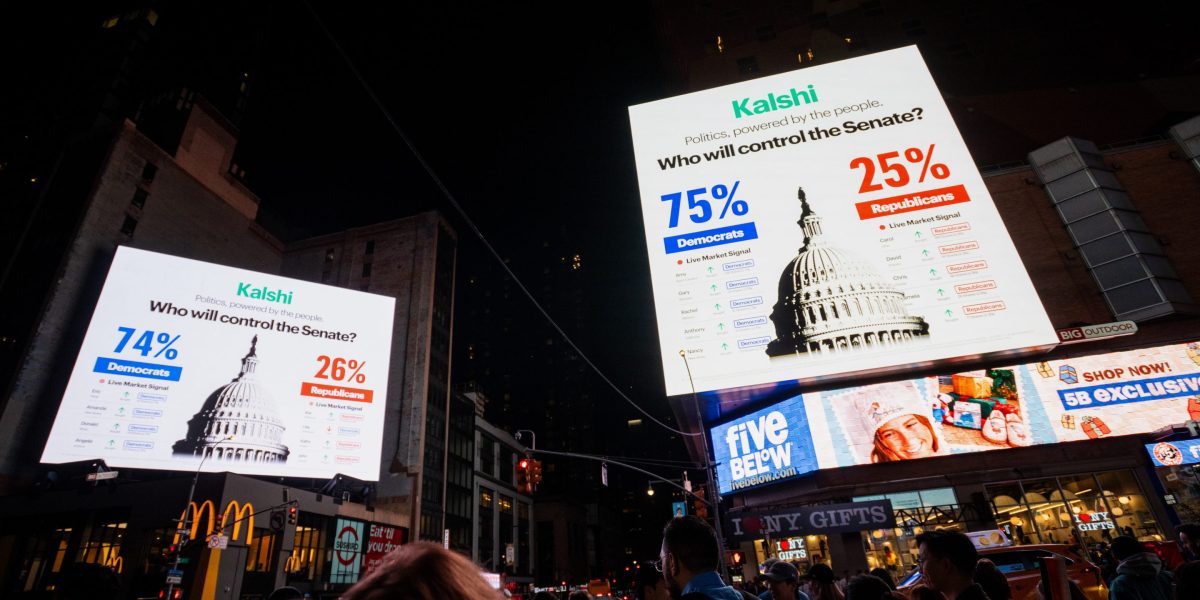
As voters head to the polls across the United States, a parallel financial phenomenon is unfolding on political prediction platforms. Midterm election trading volume on the financial exchange Kalshi has surpassed $1.4 billion, driven by heavy trading volume on high-stakes congressional and gubernatorial contests. Financial odds on the platform reflect a strong lean toward a Democratic victory, placing the probability of Democrats capturing control of the House of Representatives at 93% and their chances of taking the Senate at 73%.
The massive influx of capital underscores how prediction markets have evolved from niche speculative corners into prominent financial barometers. The highest volume centers on direct control of the legislature: a contract determining whether Republicans or Democrats will hold overall control of Congress has attracted $251 million in trades. Meanwhile, single-chamber markets for the House of Representatives have crossed $181 million, and structured bets on all four possible combinations of House and Senate power have drawn over $112 million.
Individual state and local contests are attracting substantial speculative interest as well. The Los Angeles mayoral race has recorded nearly $110 million in trading, while Texas’s high-profile Senate race is nearing $100 million in volume, with traders favoring Democratic challenger James Talarico over incumbent Republican Ken Paxton at a 71% likelihood. Conversely, in the Texas gubernatorial race, which has accumulated $21 million in trading, incumbent Republican Greg Abbott maintains a 65% probability of winning against Democratic challenger Gina Hinojosa.
The Rise and Flaws of Forecasting Markets
The momentum behind political betting platforms accelerated following the 2024 presidential cycle, when platform odds correctly anticipated key outcomes that traditional polling categorized as tight toss-ups. That success cemented prediction platforms as alternative real-time indicators for political observers and financial analysts alike.
However, the reliance on financial odds as predictive tools remains fraught with notable missteps. International and state-level markets have demonstrated that high probability numbers do not guarantee outcomes. In a recent international contest, prediction platform odds heavily favored candidate Flávio Bolsonaro at roughly 80% to defeat incumbent Lula da Silva in the presidential runoff, only for the odds to collapse rapidly as actual vote counts materialized.
Domestic primary contests have experienced similar volatility. During a gubernatorial primary election in Wisconsin, contract prices assigned candidate Francesca Hong a 95% probability of securing the nomination. Ultimately, rival candidate David Crowley won the race by less than half a percentage point, serving as a stark reminder of the distinction between speculative market sentiment and final election results.
Growing Backlash Over Financializing Civic Duty
The expansion of election-based financial trading has drawn intense criticism from observers, ethicists, and citizens concerned about the intersection of financial markets and Democratic processes. Critics argue that treating political elections as financial assets destabilizes public trust and turns civic obligations into high-stakes gambling.
Public pushback often centers on the ethical implications of financial speculation surrounding government functions, policy outcomes, and fundamental democratic rights. "Not everything needs to be gambled on," one observer noted, reflecting a broader anxiety over the rapid normalisation of betting mechanisms across civic life.
Others express concern that mainstream media coverage of prediction market pricing conflates financial wagering with genuine polling methodology. "Gamblers aren't pollsters and no serious journalist should be bothering with this tripe," another critic remarked, pointing to the risk of financial market signals artificially influencing voter perception and turnout.
As trading platforms continue to process record volume through Election Day, the broader debate surrounding their regulation and societal impact remains unresolved. Whether viewed as an efficient aggregator of real-time political information or an unwelcome distortion of the democratic process, prediction markets have established a powerful, controversial footprint in modern electoral politics.

